

Egonlab and the Lazarus collection: when the feather becomes structure
Kévin Nompeix and Florentin Glémarec took a collection about starting anew to Paris, and they resolved it in the stitching before addressing it in the discourse.
Words by

Words by Caíque Nucci
Editor-in-Chief
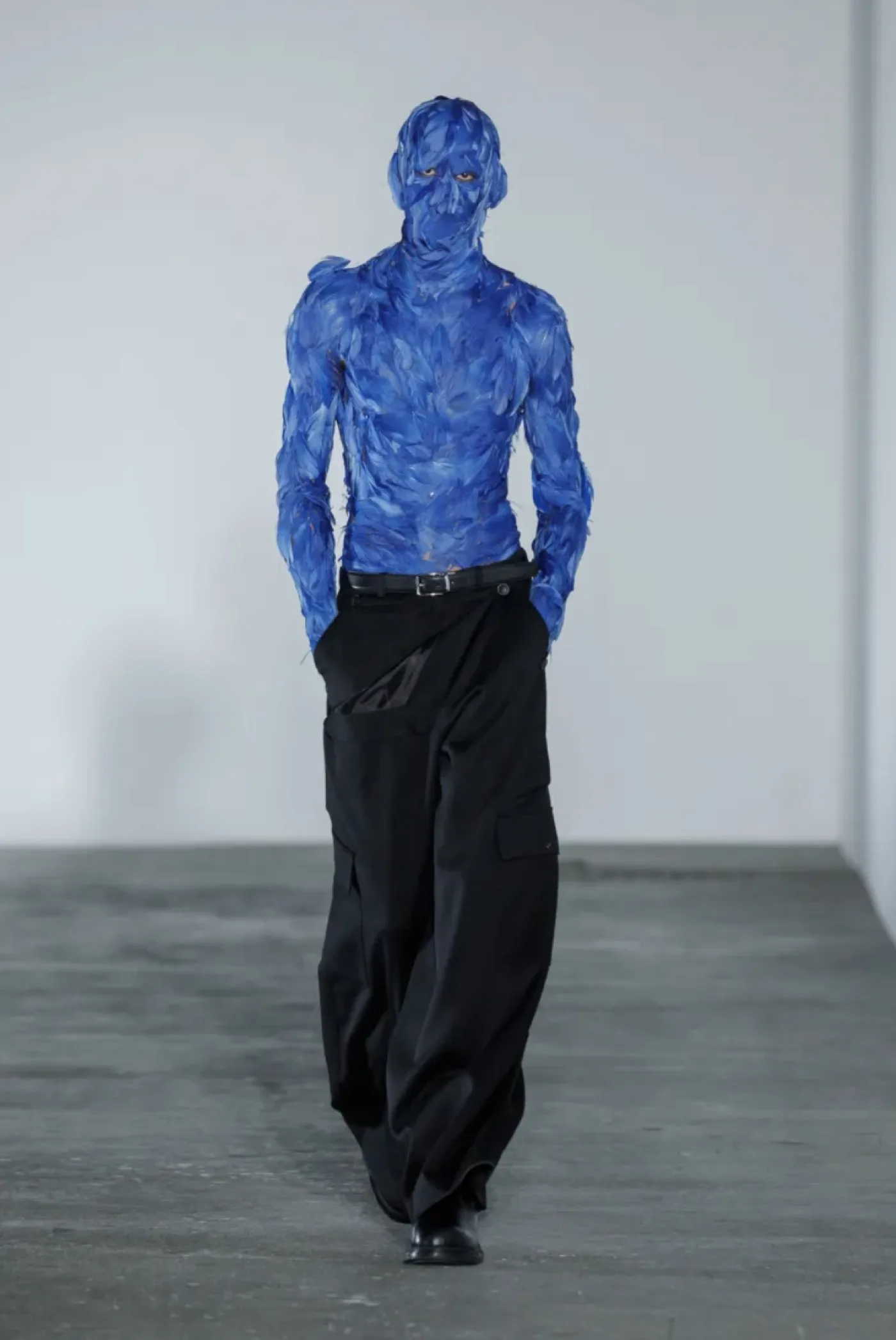
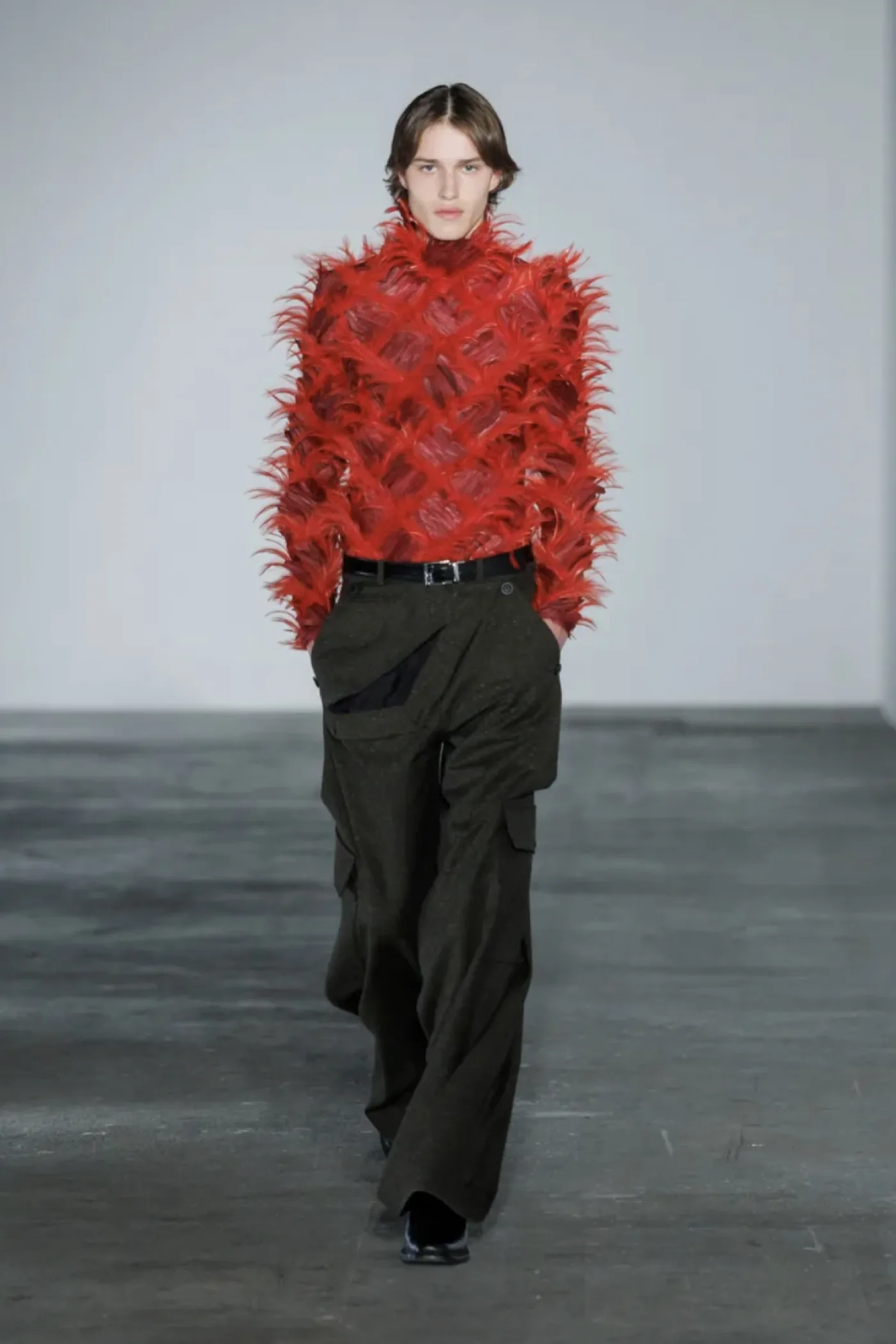
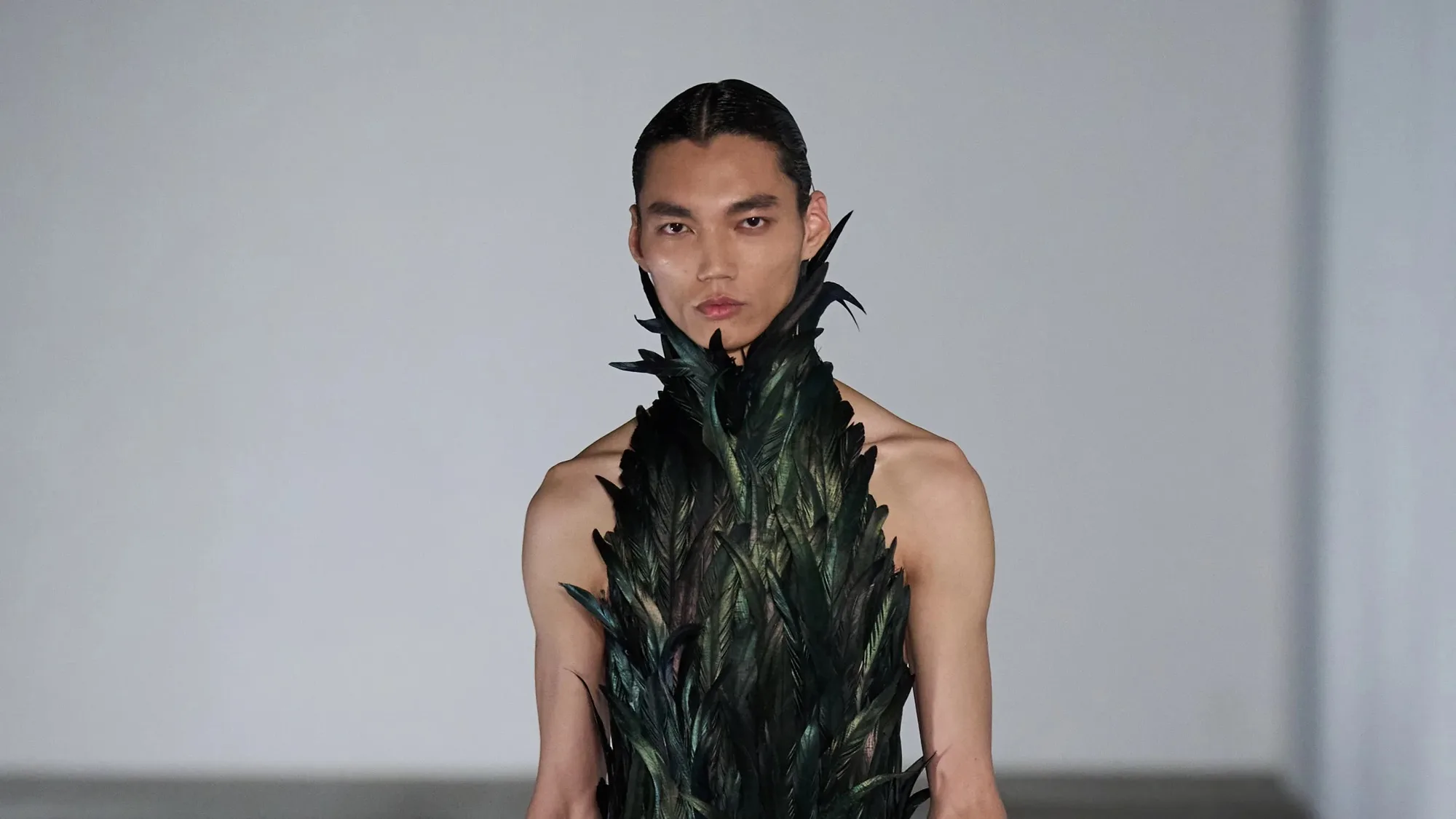
There is a difference between wearing a feathered garment and constructing a garment with feathers. The former is finishing, applied when the piece is already complete and serves to attract attention. The latter is engineering: the feather comes first, determines the volume, lifts the shoulder and defines where the body ends. The 2026 winter collection from Egonlab, presented in Paris, is built on the second idea, and that is what sets it apart from everything that resembles it in a photograph.
The duo behind the brand is French: Kévin Nompeix and Florentin Glémarec, who opened Egonlab in 2019 and saw the pandemic halt the start before it became a trajectory. Seven years later, the collection they took to the runway is called Lazarus, and the name is not a figure of speech chosen just because it sounds good.
The name of the collection is a statement of method
The show opened with a spoken text by Jameela Jamil, presented by the brand as a manifesto of resistance, renewal and refusal. In a season where almost every house talks about rebirth, Egonlab's difference is that the idea appears first in the construction of the garment and only later in the discourse. Lázaro returns with the marks of what has passed, unclean. The pieces do the same: they reveal the stitching, the patchwork and the asymmetry instead of hiding.
Black that is not just black
The collection is anchored in black, and the elegance lies in how it multiplies. Dense wool, fluid jersey and denim share the same passage, and each material returns the colour in its own way: the wool absorbs, the jersey slips, the denim breaks. There are prints that mimic crumpled fabric, which is an old eye trick, the trompe l'oeil, used here for a specific purpose. The clothing seems to have been lived in before it hit the runway.
It is against this backdrop that the feather works. In a colourful collection it would be just another ornament among many. On black, it is the only thing that reflects light, and therefore reads as structure: the red worked into diamonds across the bust, the blue that climbs the neck and covers the entire head, the dark green that frames the collar in place of a tailor’s construction.
Tailoring continues to be the spine
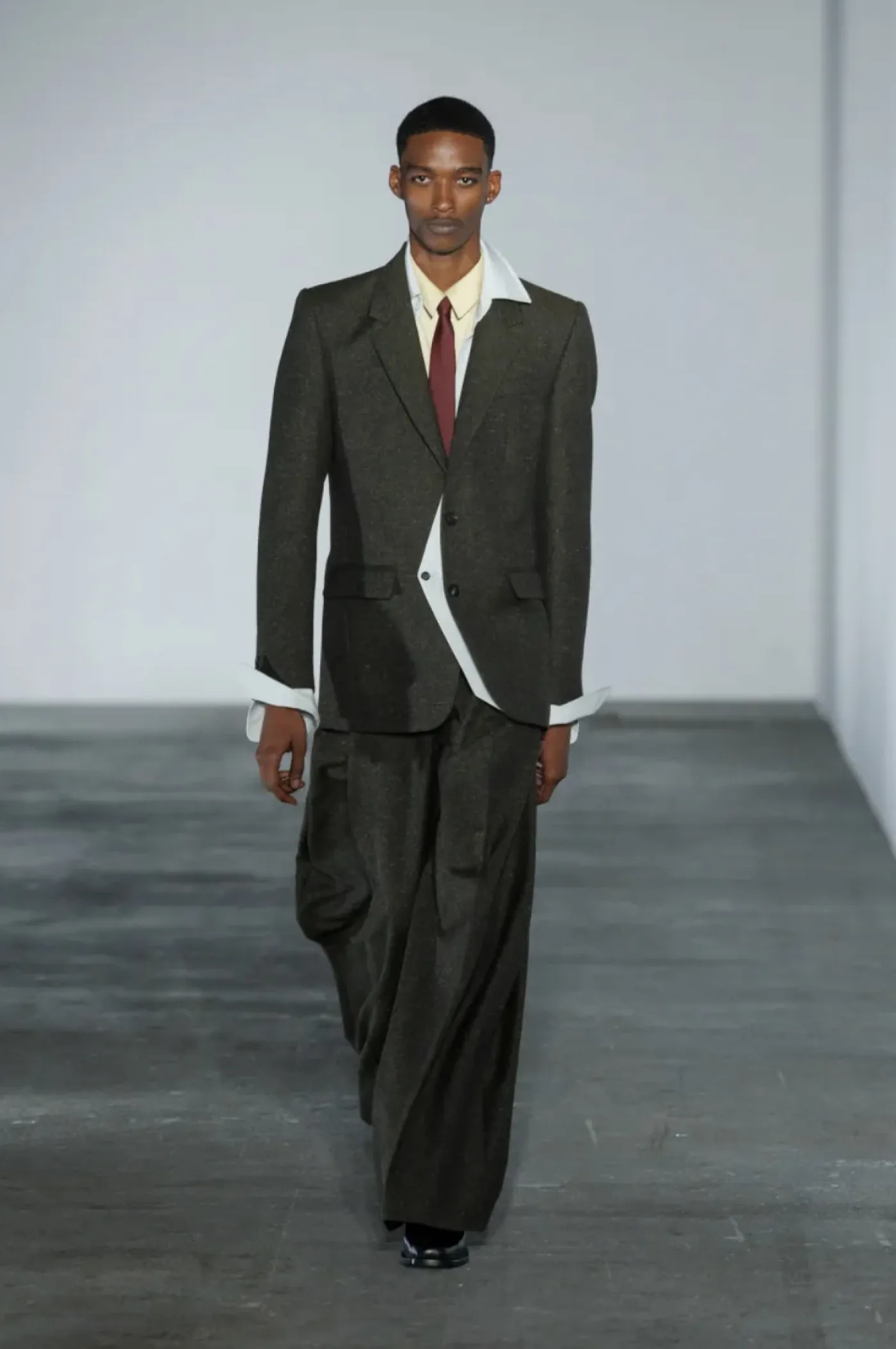
Those who only look at the feather photos miss the part that underpins the collection. Egonlab has built a reputation for off‑kilter tailoring, and it is all there: broad shoulder, waist defined by a side button closure, jacket and skirt folded over each other to create visual repetition, buttonhouse at an exaggerated scale, collar enlarged beyond the reasonable, pocket with a leather label borrowed from denim vocabulary.
None of these features is decorative. Each pushes the body's proportion to a place that conventional menswear doesn't occupy, and it is this controlled distortion, not the feather, that defines the house's signature.
Partnerships reveal who the brand is speaking to
Two collaborations were released in the same season, and both are consistent with the rest. With Tinder, a capsule called Love Will Not Tear Us Apart, featuring hybrid t‑shirts, deconstructed sweatshirts, a heart‑shaped ring and a haute‑couture feather piece with plaid, executed in the ateliers of Maison Février. Thirty percent of the profit goes to Safe Place, a feminist association active since 2018.
With Converse, a Chuck Taylor rebuilt through hand weaving applied over the entire shoe, to the point of altering its silhouette. It follows the same logic as the collection: instead of printing over a finished product, rework its surface until it becomes something else.
What remains
Egonlab is doing today, with feather and wool, what other fields do with technology: treating the material as the subject of the work, not as the final layer applied after the work is finished. In a season of large houses restarting with new creative direction, an independent brand that survived its own interrupted start is the one that emerges with the most developed argument.
That is why the collection matters to those working in fashion in Brazil. It shows that a small house can sustain a recognizable signature without a conglomerate budget, provided the technical decision and the aesthetic decision are one and the same. It is a lesson in method before it is a style reference.
Complete TV · Reels
Maja Petrić: the artist who wrote her own artificial intelligence
See on InstagramFrom Complete





More from Caíque Nucci
View profile
Latest from Complete
 FashionGuccicore: plurality as a language of style
 BeautyISDIN Fusion Water Magic: sun protection with lightness and technology
 The CoverIn the beginning, we couldn't even use the word handicraft.
 DesignTomie Ohtake House‑Studio presents Zanine Caldas
 CultureThievery Corporation, 30 years: the Washington duo that originated in bossa nova
 The CoverBrazil still gives little recognition to genuinely Brazilian authorial fashion.
 InnovationLight has become a building material