.png)
Working between painting, illustration and kinetic sculpture, the German artist develops a work that observes everyday gestures and translates them into physical systems in motion.
The work of Jakob Grosse-Ophoff is built from a precise point of friction: the encounter between body, movement and mechanics. Working between painting, illustration and kinetic sculpture, the German artist develops a work that observes everyday gestures and translates them into physical systems in motion.
Originally trained in mechanical engineering, Grosse-Ophoff fully migrated to artistic practice in 2019. What might sound like a rupture became, in fact, a structural axis of his production. His technical mastery does not appear as an ornament, but as a language. Motors, cranks, belts, and gears are used to drive arms, heads, or trunks that repeat simple, almost banal actions with insistent precision.
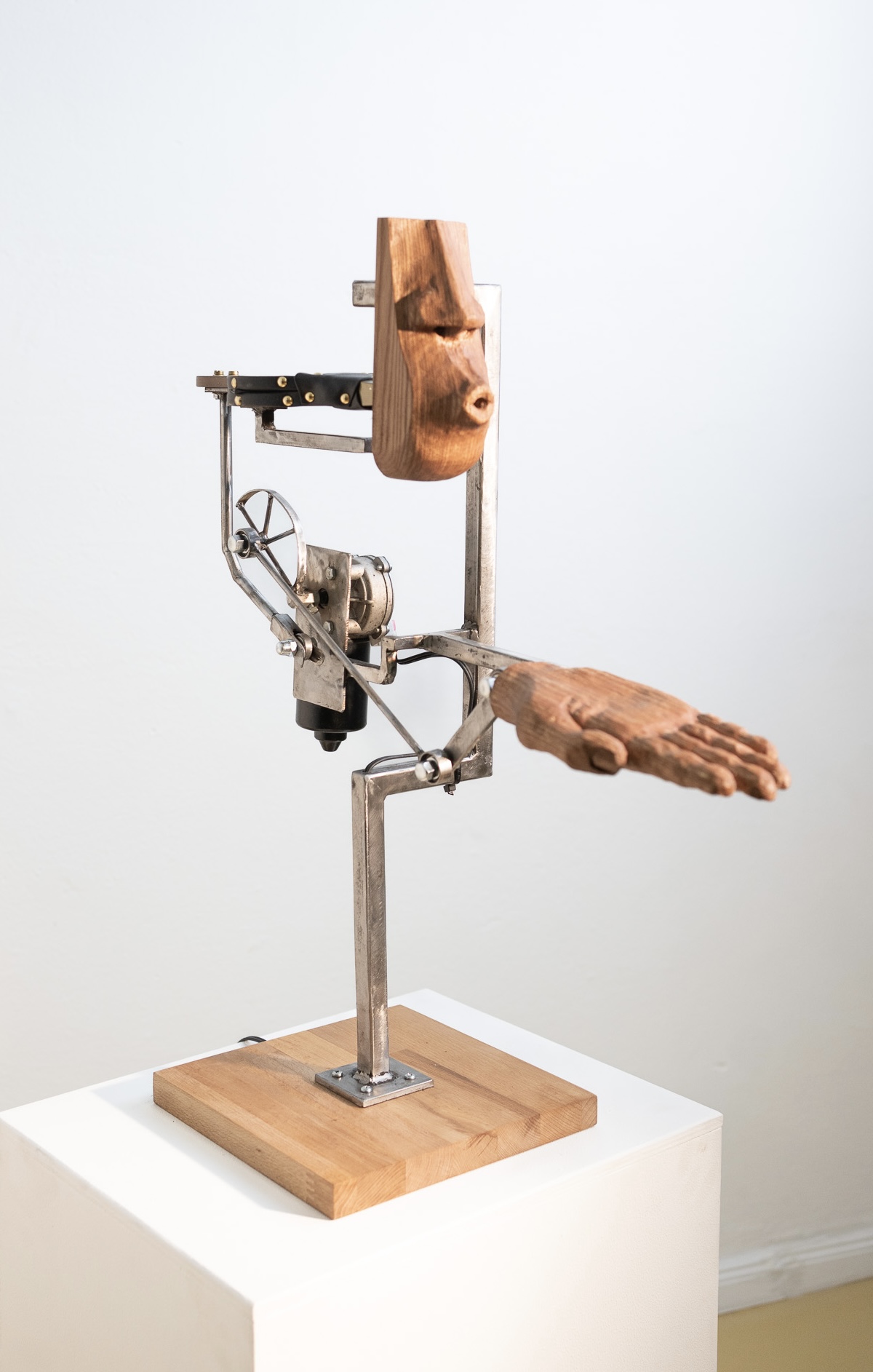
These moving sculptures don't seek the technological spectacle. Rather, they operate in a zone of subtle strangeness. The gestures are recognizable but out of place. Mechanical repetition transforms the familiar into something unstable, sometimes comical, sometimes uncomfortable. The body, fragmented and programmed, comes to exist as a system.
Grosse-Ophoff's work is part of a hybrid territory, where art and technology are not opposed, but are contaminated. There is constant attention to the materiality, rhythm, and cadence of movements, as if each work were also a study of time and control. The artist observes how human actions can be codified, automated and yet preserve an expressive charge.

More than representing the machine, his sculptures reflect on the human before it. They talk about repetition, about conditioning, about behavior. They question the extent to which the gesture is spontaneous or the result of a system that precedes it. By animating the inanimate, Grosse-Ophoff returns to the viewer an unsettling image of himself.
Between technical ingenuity and sensitive observation, his work proposes a direct reflection on the ambiguity between man and machine — a theme that is increasingly present in contemporary culture, treated here with economy of means and conceptual precision.